A strategy is a senior management’s plan of action in which the efforts of the staff are coordinated to ensure a long-term relationship in business.
Types of Strategies
There are two types of strategies used in implementing relationship marketing
Company-to-Company
According to Ballantyne (2000), relationship marketing signals a strategic shift in managerial thinking from extracting transactional value to developing mutual value through relationships. Hard work, resources and patience to face all new acquaintances who long to be part of a new close relationship and network are involved (Zineldin, 2002).
Each phase of the relationship life cycle forms a high level of cooperative effort and differences in information, expectations, experiences, needs, wishes, strategy requirements and consequences.
The phases of relationship development and the duration of each phase may vary considerably depending on the following:
- Involved partners;
- Nature of potential relationship;
- Nature of values to be exchanged.
Therefore, a good strategy needs to be applied so as to develop a strong bond within the companies. Companies must consider each relationship as part of a portfolio of relationships and develop separate strategies and expectations (Zineldin, 2002).
Company-to-Employee/Organisation (Staff)
Internal marketing focuses on employees in the organisation. According to Brink and Bernt (2008), internal marketing refers to the relationship that develops between the employees of an organisation and the organisation itself, to facilitate the implementation of a customer relationship management (CRM) programme.
Why is internal marketing so important? Firstly, because it is the best way to help employees make a powerful emotional connection to the products and services that your organisation sells. Without that connection, employees are likely to undermine the expectations set by your organisation’s advertising. In some cases, this is because the employees simply do not understand what your organisation have promised the public, so they end up working at cross- purposes.
In other cases, it may be that they do not actually believe in the brand and feel disengaged or, worse, hostile toward the organisation. When people care about and believe in the brand, they would be motivated to work harder and their loyalty to the company increases. Employees are united and inspired by a common sense of purpose and identity.
Most quality experts agree that a strong leadership by the senior management is critical in developing and sustaining a quality-based culture in an organisation. Good leadership and innovation will establish and communicate the purpose, vision and goals of the organisation and determine core business strategies with its workers (Shams-ur Rahman, 2002).
According to Ballantyne (2000), this strategy is known as “happy staff equals to happy customers.” This staff climate/customer satisfaction link is also emphasised by others. Staff will be more committed when they believe that they (as staff) are needed to increase the customer value.
Therefore, “staff satisfaction” becomes a possible indicator of the process of internal marketing in action rather than its goal. Whatever strategies used, the goal is to enhance the customer consciousness of employees or customer perceived performance, or more broadly, stakeholder value (Ballantyne, 2000)
Relationship Life Cycle (ZLC)
According to Zineldin (2002), relationship life cycle (ZLC) consists of four different phases. These phases are discovery phase, development phase, commitment phase and loyalty phase.
Later in 2012, Zineldin added a fifth phase into the relationship life cycle, namely the dissolution phase. Now, let us learn more about these phases.
Discovery phase
During this phase, the companies identify their needs and willingness to start a strategic relationship arrangement. If, at this phase, the parties discover that they failed to understand each other’s needs and wants, not able to develop an appropriate offering or act in a manner inconsistent with expectations, then the next phase will probably not occur (Zineldin, 2012).
Since uncertainties are greater in the earlier phases, it is very important for marketers to highlight the objectives of the business, its strengths and the key strategic implications such as the following:
- to identify potential customers;
- to create interest in the company and its product/service packages;
- to deliver a wide range of product/service package options;
- to talk and listen to customers or intermediaries.
- To precisely understand the customers’ needs and wants and to what extent these needs are being met, what do they use to manage their needs at the present time;
- To emphasise the most appealing feature of a companyÊs competence and product/service.
Development phase
According to Elram (1991), the objective of the development stage is to formulate a relationship and explore whether a mutually beneficial relationship is possible. At this stage, the parties are becoming familiar with each other and they are sure about the object-related value. They will acquire some more knowledge of each other’s norms and values as a result of their interactions (Zineldin, 2012).
The key strategic implications and the effective mix elements in the development phase are for marketers to function in the following ways:
- to convince the customers that their requirements will be fulfilled by the benefits of the product/service on offer;
- to identify future customer needs and wishes more efficiently and effectively;
- to identify the level of satisfaction currently obtained by customers;
- to monitor customer queries or complaints; to identify trends in attitudes to the company;
- to identify current and future key clients by conducting a customer analysis.
Commitment phase
Commitment refers to an implicit or explicit pledge of relational continuity between the exchange partners. At this phase, maintaining product/service quality and performance are the most important marketing task. The degree of customer loyalty and retention is higher at this phase (Zineldin, 2012).
Some key relationship mix elements and strategic implications for sustained advantage are as follows:
- adaptation, innovation and product/service attractiveness are more important;
- professional/individual contact is most important to “clientising” the relationships;
- marketers should be able to reduce deficiencies;
- marketers have better opportunity to talk to clients and to understand how they view the company and its ability to solve their problems and satisfy their specific needs and wishes.
Loyalty phase
The relationship is now a strong, loyal relationship. Commitment, experiences, expectations, flexibility, adaptations, capability and ability to create added value are very high. The main goal of this phase is to maintain and stabilise the strategic business relationship while each partner achieves the benefits of close cooperation and association (Zineldin, 2012).
The loyal partners develop mechanisms – structure, processes and skills – for bridging organisational and interpersonal differences and achieving real value from the strategic business relationship. These mechanisms and processes ensure interdependence.
Some key strategic implications at this phase are as follows (Zineldin, 2012):
- loyal clients feel that they are receiving values/meanings and are willing to pay premium price for the benefits of the products/service offerings and the mutually beneficial relationship;
- the organisation is expected to use the latest IT tools to gather and store data about every individual client;
- trust, ethical values and mutual dependence increase rapidly as the relationship gains strength;
- flexibility and high ability of commitment and problem-solving must always exist; and the ability to create new/additional value together is higher.
Dissolution phase
Dwyer, Schurr and Oh (1987) stated that the dissolution phase may occur in any of the previously mentioned phases. Zineldin (2012) also agreed that it is the final phase of the relationship life cycle.
Strategy Frameworks and Components of Successful Relationships
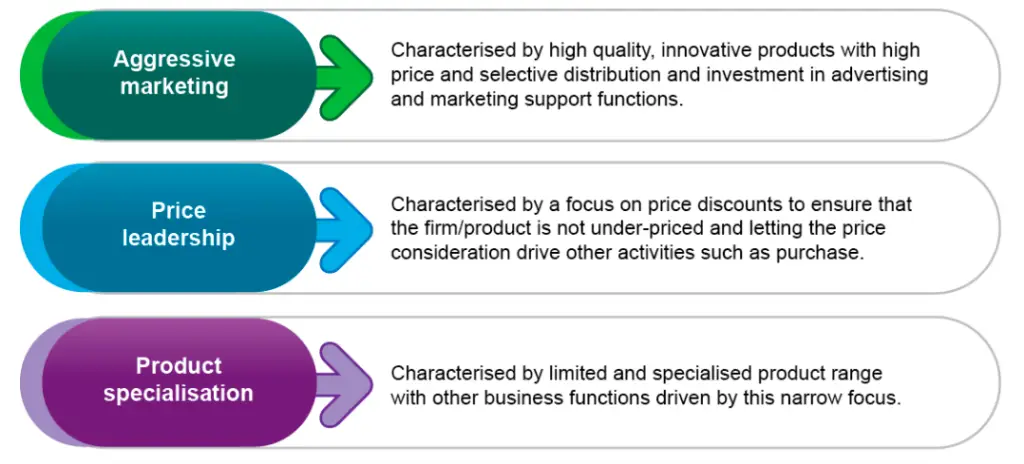
Let us discuss more about marketing strategy. Research conducted by Paswan, Blankson and Guzman (2011) relied on the strategy frameworks suggested by Porter (1980) as well as Slater and Olson (2002) to operationalise the notion of marketing strategy as shown in Figure 5.4.
Source: Paswan, Blankson & Guzman (2011)
Main Components of Successful Relationships
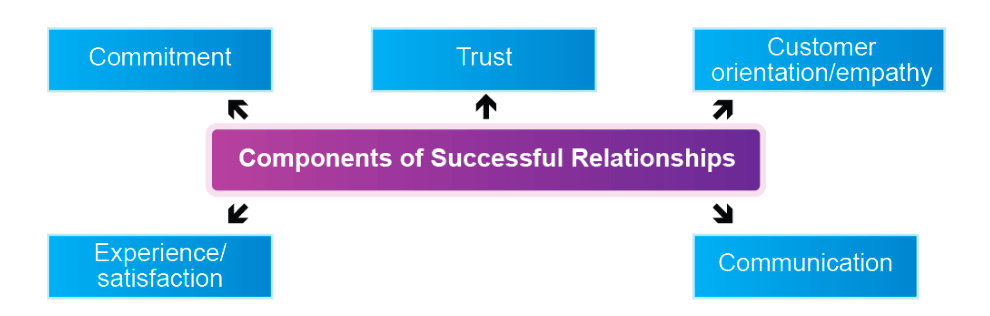
According to Conway and Swift (2000), there are several components are involved in the implementation of a successful relationship marketing strategy. The main components of successful relationships are:
Commitment
- It is of central importance in developing relationships.
- It is the strongest predictor of voluntary decisions to remain in the relationship (Rusbult, 1983).
- Influenced by social bonding, which is the degree of mutual personal friendship and liking shared by partners who have a strong personal relationship. They are more committed to maintain the relationship than less socially bonded partners.
- The greater the level of investment made by a manufacturer in a relationship, the greater the increase in that manufacturer’s commitment to its relationship with its distributor.
Trust
- The precondition for increased commitment.
- As a generalised expectancy held by an individual that the word of another can be relied upon.
- Ali and Birley (1998) identified two types of trust: – Characteristic-based trust because of who they are, which pertains only to individuals; and – Process-based trust because of how they behave, which refers to the associations between “trust and long-term relationships”.
- Established through interactions and combined with other external factors such as word-of-mouth opinions and media reports about the seller to form an overall perception of trust on the seller.
Customer orientation or empathy
- It refers to the understanding or the ability to see a situation from someone else’s point of view although many use the term synonymously with affinity and liking.
- The greater the degree of empathy or “liking” between the parties concerned, the fewer the barriers to relationship building.
- Liking a particular individual (or group of people) projects a more positive outlook towards that person.
Experience or satisfaction
The more satisfied the customer, the more durable the relationship (Buchanan & Gillies, 1990).
Communication
- According to Schramm (1954), communication is a process of establishing a commonness or oneness of thought between a sender and a receiver.
- In the field of marketing communication, a new trend towards integrating communication elements such as advertising, direct marketing, sales promotion and public relations into a two-way integrated marketing communication perspective emerges.